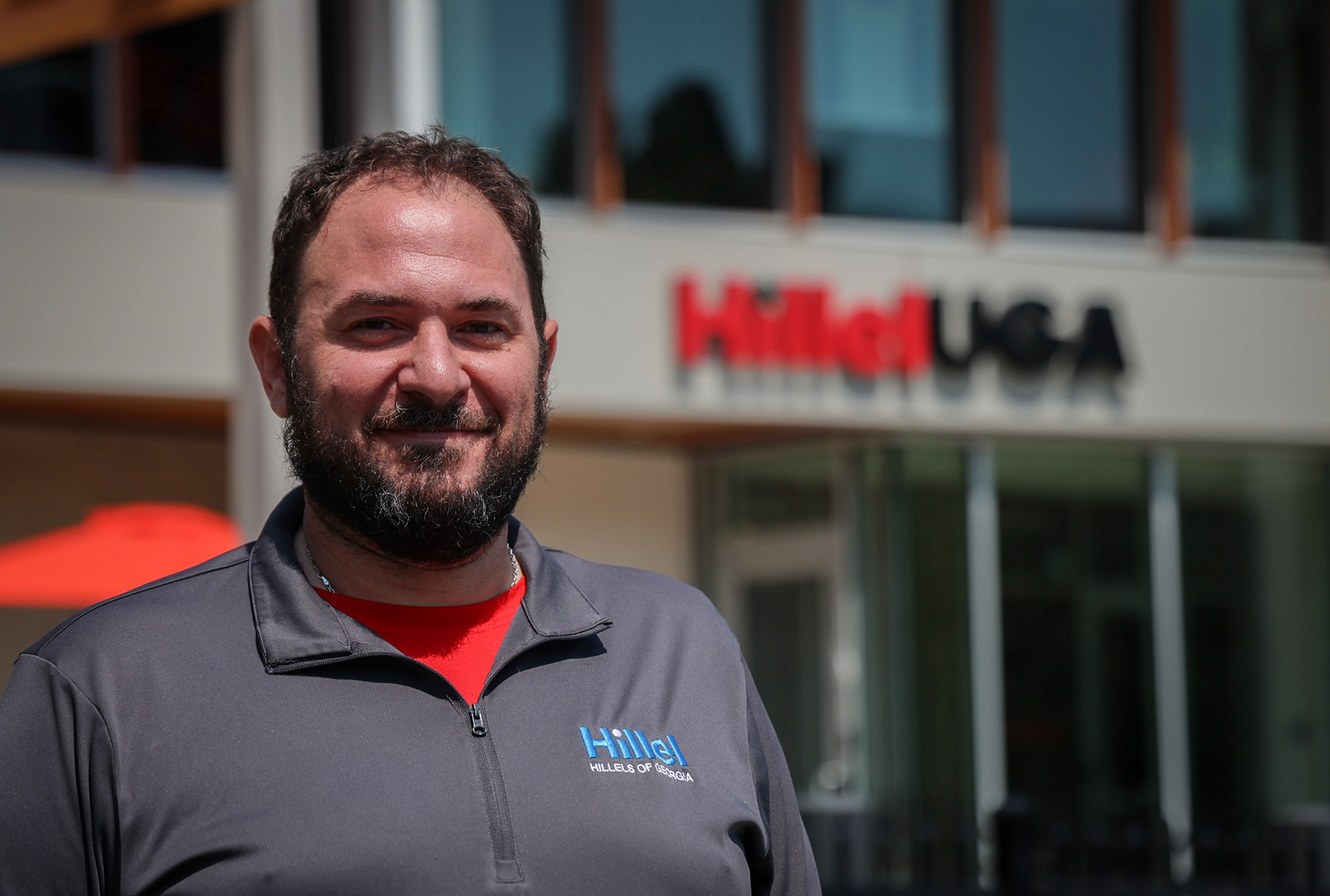
Jeremy Lichtig, Campus Director at Hillel at University of Georgia, poses in front of the Orkin Hillel Center in Athens, Ga., on Wednesday, Sept. 17, 2025. Lichtig has served at Hillel at University of Georgia for over 10 years.(Photo/Emily Laycock)
UGA Hillel Director says Jewish students feel supported amid the national rise in antisemitism
By Emily Laycock
Jeremy Lichtig, campus director at Hillel at University of Georgia, shares how Jewish students at UGA have navigated the rise of antisemitism on college campuses across the country with the help of the UGA and Athens community.
Q: There was a recent survey done by the Anti-Defamation League where 78% of Jewish students said they conceal their identity on campus. Is this something that you have noticed with students?
A: So the ADL does report cards, and we got an A. UGA got an A because of the hard work the community does to make sure all students feel a part of the community as best they can. I would say it's probably a bell curve. I would say there are far less students that are worried about hiding their identity. I think it was two years ago, the gentleman with the Instagram handle of Kippah Kid went here so he was promoting, like, taking pictures with his kippah everywhere, so that stuff is not unusual here.
Q: So you would say that's not really an issue that many students are facing here?
A: I would say each student feels it in some way, because it's (antisemitism) on social media. I think day to day, they deal with it less than other campuses. We encourage students to show their Jewish pride in whatever way resonates with them. And I would say they're able to do that where other campuses that might not be the case
Q: Do you feel the community here felt the response that UGA put out when the first encampment (on April 29, 2024) happened was appropriate and felt supported in that?
A: I think it was very individual. I think that parents felt supported that those sorts of things weren't allowed on campus and the standard was already set beforehand, the rules were what they were and that they held up those rules. And the Jewish students, I think, felt afraid in some ways, not necessarily what's happening here, but what they felt could happen by watching other schools. And with UGA following the rules that they set up, that made them a little bit more relaxed. It just seems that the rule is as long as you're not taking away from other students' experiences, please be yourself, like do whatever you want, but that there is a line that if you cross there are repercussions for it.
Q: Is there anything else you want to share?
A: The university is great, like this is a very unique place. I was recently asked by a staff member, "What's your next step?" And I'm like, unless they can transport UGA to a southern beach somewhere. This is the place. The Athens community is fantastic. The UGA community is fantastic. The community is very, very caring.
Q: So you feel like the Athens community has supported the Jewish community in Athens?
A: Yeah. After the shooting in Pittsburgh, five, six, a while ago, it was pre-COVID. The Athens police officer stopped by the Hillel house and just said, “We want you guys here, how can we make you feel supported?” I told my parents that up in Baltimore and they were like “What?” I’m like, yea, like this is that community, so they realise what is happening and try to support the people that are here.
Comments trimmed for length and clarity.
Why I Wrote The Story
I chose to interview a prominent Jewish leader in the Athens community for my Q&A, because last year I closely covered the pro-Palestine protests that were taking place on the University of Georgia's campus. Through those experiences I witnessed at times a seemingly considerable amount of tension between the Jewish student community and the greater UGA community. Thus, when conducting this interview my goal was to gain greater insight about the overall sentiments of Jewish students on campus.